Giorgio Caproni, one of the most refined and intense voices of 20th-century Italian poetry, was born on January 7th 1912 inLivorno, into a family of modest means. His poetic production, infused with deep human sensitivity and acute existential awareness, explored universal themes such as solitude, pain, death, and the search for meaning, making him a central figure in the Italian literary landscape. His life, marked by difficult experiences and profound emotional bonds, was key to understanding the essence of his poetic vision.

Caproni spent his early years in Livorno, a city that would always remain in his heart and in his work. His mother, Anna Picchi, a central figure in his emotional and poetic development, would symbolise a profound affection that would accompany the poet throughout his life. In 1922, the family moved to Genoa, a city Caproni would consider his second homeland and which deeply influenced his poetic production. Here, Caproni became drawn to literature, showing from a young age a great passion for reading. He eagerly devoured the works of Italian and French classics, and was particularly fascinated by the poetry of Baudelaire, Rimbaud, and Mallarmé—influences that would be reflected in his formal and thematic exploration. Caproni also developed an interest in music, another great passion that would accompany him throughout his life. This love for music, especially the violin, fueled his sensitivity to rhythm and the musicality of verse, which became distinctive elements of his poetry.
In 1936, Caproni published his first collection of poems, Come un’Allegoria (Like an Allegory), though it did not receive much critical attention. This debut, characterised by a symbolist vein and some expressive experimentation, marked a first step in what would become a rich and complex literary career. In 1940, when World War II broke out, Caproni was called to serve in the military. The armistice of September 8th 1943 saw him join the Resistance against the Nazi-fascist occupation. In 1947, he published Cronistoria (Chronicle), a collection that marked a turning point in his poetic style. In this work, Caproni moved away from symbolist influences to embrace a more essential and concrete poetry, where the theme of the journey became central, serving as a metaphor for human existence—a path that is uncertain and painful, moving towards a goal that seems elusive and unattainable.

In the 1950s and 1960s, after moving to Rome, Caproni published other important collections, including Il Passaggio d’Enea (The Passage of Aeneas) in 1956 and Congedo del Viaggiatore Cerimonioso (Farewell to the Ceremonious Traveler) in 1965, where the theme of travel merges with the theme of bidding farewell. The journey becomes a path toward death, the final destination of every human being, but also an opportunity to reflect on the fragility and precariousness of existence.
The figure of his mother, Anna Picchi, is central to Caproni’s poetry. In the collection IlSeme del Piangere (The Seed of Crying) in 1959, Caproni dedicates a series of poems to his mother, which are among the most touching and intimate of his entire body of work. In these poems, the mother becomes the symbol of a lost past, of an emotional world that can no longer be recovered, but which continues to live in memory and in the poetic word. Death, loss, and mourning become recurring themes in Caproni’s poetry, in which he explores the relationship between life and death with rare clarity and depth. His poetry does not offer consolation or definitive answers, but reflects the uncertainty and doubt that characterize the human experience. The sense of mystery and the unknowability of reality are always present in his work, which constantly questions the meaning of life and the impossibility of finding an absolute truth.
In the final years of his life, Caproni reached full poetic maturity, publishing some of his most important and experimental works. Il Muro della Terra (The Wall of Earth) in 1975 and Il Franco Cacciatore (The Free Hunter) in 1982 marked a shift toward a more abstract and metaphysical poetry, where the poet confronts nothingness and the absence of meaning. His reflection becomes increasingly bitter and disillusioned, yet at the same time profoundly human. Caproni passed away in Rome on January 22nd, 1990.
Work connected to the Maremma
Giorgio Caproni was described by Carlo Bo as the “poet of the sun, light, and sea,” elements that can also be found in the poems dedicated to Maremma. Its wild beauty and isolation represent, for Caproni, the fundamental elements of an imaginary world where existential searching, solitude, and one’s relationship with nature converge, reflecting humanity’s eternal struggle with fate and uncertainty. Already in his debut collection, ComeUn’Allegoria (1936), we find verses dedicated to this land, Ricordo di Maremma (Memory of Maremma), which later appeared in Il Passaggio d’Enea (1956) under the title Sera di Maremma (Evening in Maremma):
“On the free spring meadows/sweating, unbroken colts/in wild chases./In the sky at this hour it burns/like the cheek of a child/with fever.//The earth appears as frail: of voices and warm/breezes./They burn,/so joyously/bonfires, the colours of child’s play.”
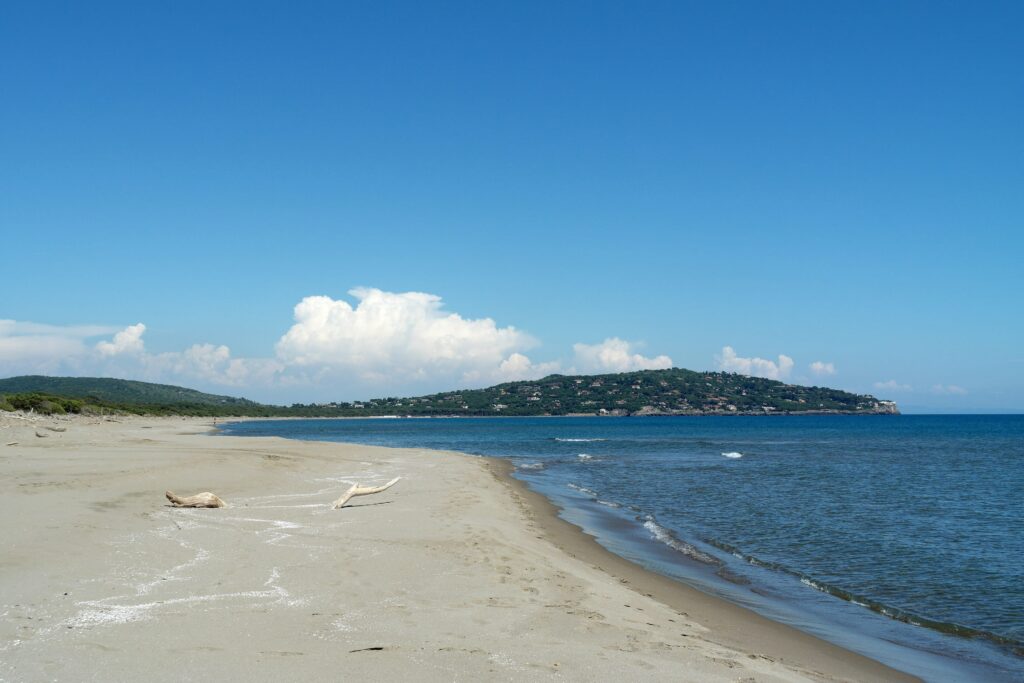
The Maremma stands out as a seemingly desolate landscape, but at the same time, it is full of meaning. It is not the touristy or picturesque Maremma, but a harsh and rugged place where the poet confronts the vastness of the land and the sense of bewilderment that arises from it. In this natural setting, Caproni transforms his feelings of precariousness and existential uncertainty, representing Maremma as a metaphor for life itself: an open, mysterious, and often hostile space, which invites reflection but offers no definitive answers. The Maremma landscape, with its empty spaces, forests, and uncultivated land, becomes the stage for a solitude that is both physical and internal.
Later, in 1939, Caproni published the poem Alla Maremma (To Maremma) in the second issue of the magazine Ansedonia. Rivista di Letteratura e Arte, directed by Antonio Meocci from Grosseto and Geno Pampaloni. In this text, which later appeared in L’Opera in Versi (1998), Caproni offers an invocation to Maremma: “virgin,” “cursed,” and “land of malaria,” which, thanks to land reclamation, transforms into a “stern mother” who offers gifts to “hardworking children.” The celebration of land reclamation and the allegory of Maremma are paired with the realistic and Capronian image of wild horses, already present in Ricordo di Maremma.
Anecdote
In 1940, Caproni collaborated with the second series of the magazine Ansedonia, which in 1941 changed its name to Lettere d’Oggi. Rivista Mensile di Letteratura, losing its local connotation. It was in the editorial office of the magazine that in 1942 he met Carlo Cassola, who was deeply impressed by him.