Mario Luzi was born in Castello, near Florence, in 1914. He graduated in French literature with a thesis on François Mauriac. In 1935, he published his first poetry collection, La Barca. His study of French literature and the influence of Hermeticism on the literary scene of the time played a crucial role in shaping his early poetic output. The collections that appeared in the 1940s (Avvento Notturno, 1940; Un Brindisi, 1946; Quaderno Gotico, 1947) were followed by Primizie del Deserto (1952), Onore del Vero (1957), and Nel Magma (1963), in which the search for essence and interiority intertwines with the perception of appearances: “It is a vague figure, it knows no rest… / […] through dark paths where nothing lives anymore, / nothing but the hope of thunder.”

In his later collections (SuFondamenti Invisibili, 1971; AlFuoco della Controversia, 1978), Luzi’s poetry took on a choral form, where a mature expressive tension led him to explore profound civic themes and a lofty, spiritual vision of life—an approach that would characterise both his poetry and his prose in his later years.
Appointed Senator for life in 2004, Luzi passed away in Florence on February 28th 2005. Both of his parents were from Maremma, specifically from Samprugnano (now Semproniano), where Luzi spent his summers at least until 1940. He was deeply attached to his mother, who, along with other experiences and readings, played a decisive role in shaping his Christian sensibility: “I was fascinated by her ability to transport everything into an interiority that perhaps the modest society we lived in did not perceive as a primary need. Christianity, for me, was first and foremost an admiration and an imitation of my mother. I entered through that door—a natural one, yet also selective. Other religious women or catechism experiences meant nothing to me; in fact, I was rather impatient with them.”
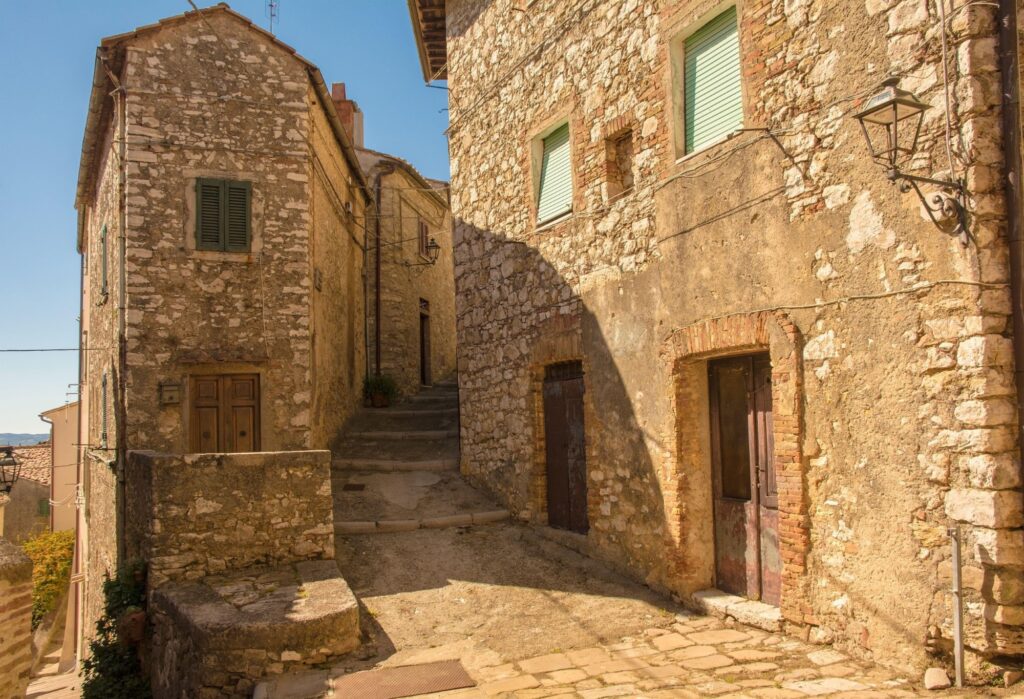
Thus, beyond being his parents’ birthplace, Semproniano became a place of inspiration—deeply connected to both agricultural and spiritual culture, which played a crucial role in his development: “In childhood, my point of reference was the village, Samprugnano.”
In the poem Casa per Casa, this connection emerges clearly: “It is a village I wander through in my mind / House by house, tomb by tomb: its struggles and its feasts, year after year, / were my thorns, my wine as well.”
It is a land of memories and presences that, in the course of time, return only to reaffirm the (possible) meaning of their disappearance, as seen in Nella Casa di N., Compagna di Infanzia: “The wind is a harsh Lenten wind / it moans through the cracks, under the doors / whistles through the invaded rooms, and flees (…) I am here, a person in a room / a man deep inside a house, listening / to the screech of the flame, the heart / quickening its beats, I sit, I wait. / Where are you? Even your trace has vanished… / If I look here, I see the fury, and beyond / the grass, the grey poverty of the mountains.”
Over time, his birthplace comes to represent a deeper understanding of existence, as seen in A Mia Madre dalla Sua Casa. Returning to his mother’s home coincides with returning to the land of Maremma: “Your old, grey house welcomes me / lying on my back on a narrow bed / perhaps the bed you slept in for years. I listen, / I count the slow hours passing / made even slower by the clouds drifting / through these August nights in these harsh lands.”
Here, memories intertwined with the present take on a tone of waiting, revealing a profound existential truth: “I do not sleep; I follow the steps of the night wanderer / whether mad or a tormented youth / while they echo over stones and pebbles / I let go and take up my servile burden / and I descend, descend deeper than I already am / into this time, into this people.”
It is no coincidence that, in a youthful article published in the Corriere dell’Adda in 1953, entitled Monte Amiata, the now mature Luzi—who had long since left his homeland—revisited the same theme with a deeper awareness: “The village boy dreams instead of escaping to the city, as so many before him have done, sometimes with some success. But in any case, he will never truly detach himself from it—he will continue to be part of the living body of the community, carrying it in his thoughts, remaining in the unbroken memory of the village, which passes down everything without losing anything. For now, the one and the other—boy and village—live their perfect earthly existence together, venturing along the slopes, disappearing into the undergrowth, or slipping through tiny wooden gates into the vineyard, into the small fields where the water basin glistens beneath the branches, and the fruits stand out, ready for their snack. Then, when the deep shadows shift and turn blue, they return and linger in the square, forming a circle around the solemn old men sitting on the low wall or the steps. Under the still-glowing sky, they recount stories of other eras and distill the ancient and eternal wisdom of their lineage.”